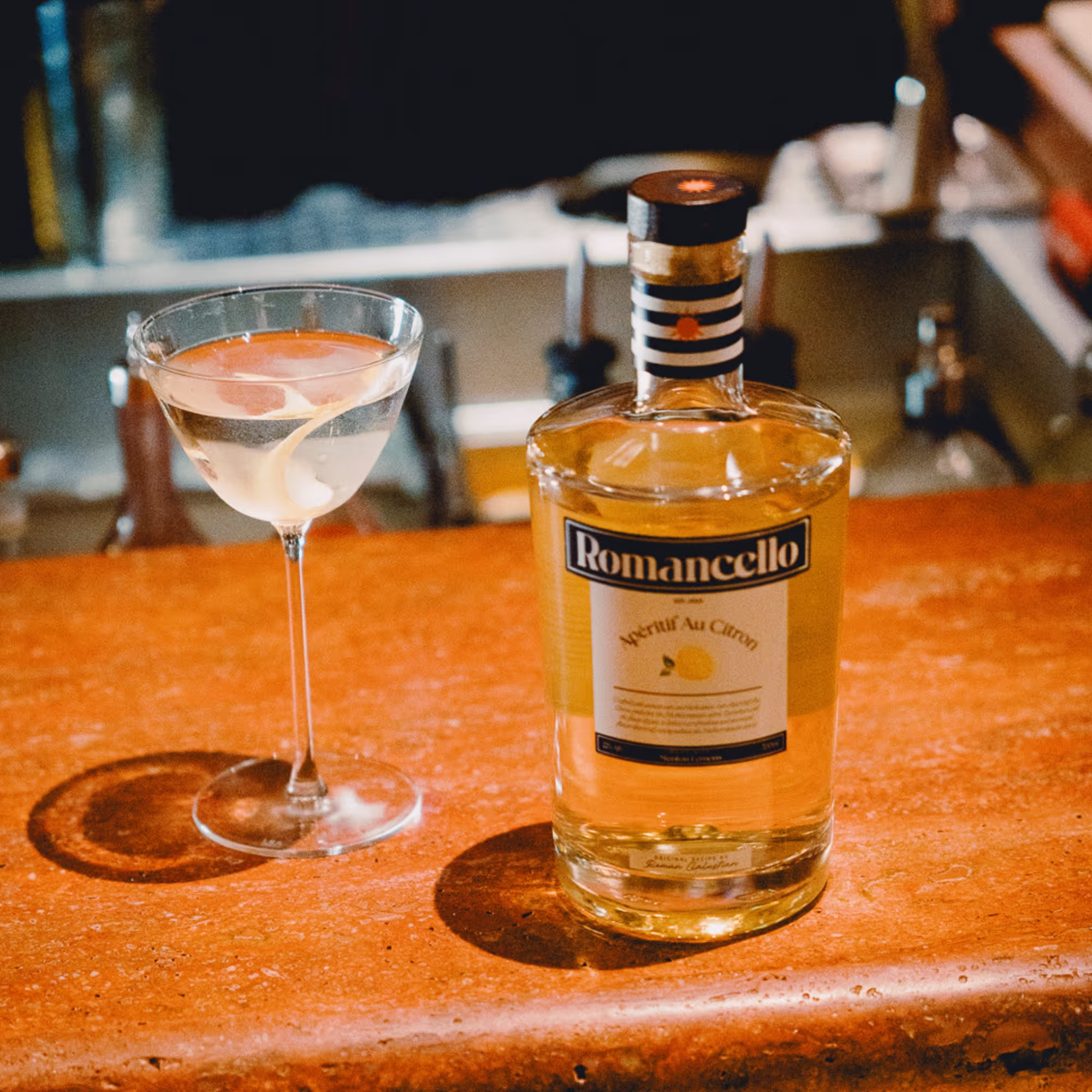
Few drinks carry as much ceremony as the Martini. A stemmed glass, frosted cold. A clear, perfectly still surface. A twist of lemon peel and a moment of quiet before the first sip. It is the most recognisable cocktail silhouette in the world, and it has been for well over a century.
We made ours with Romancello. Sixty millilitres, a whisper of dry vermouth, ice, patience. Here is the recipe, and a few thoughts on why the Martini never goes out of style.
A drink with many origin stories
Nobody agrees on where the Martini was born. Some trace it to the Martinez, a sweeter gin-and-vermouth drink served in California in the 1860s. Others credit a bartender at New York's Knickerbocker Hotel in the early 1900s, and a few point to a bar in Arma di Taggia, on the Ligurian coast, a short drive from Menton. The honest answer is that it evolved, one bartender's tweak at a time, until it settled into the form we recognise: spirit, dry vermouth, ice, garnish.
That simplicity is the point. With only two ingredients and no place to hide, the Martini rewards quality, temperature and restraint. It is less a recipe than a discipline.
Why everyone is drinking Martinis again
The Martini has never really left, but the last few years have given it a second wind. Bars have built whole menus around it. Dirty, dry, wet, vodka, gin, even the Espresso Martini that conquered a generation of Friday nights, the name has become shorthand for a certain kind of evening: dressed up, unhurried, a little bit theatrical.
Part of the appeal is the ritual, and part is the shift towards drinking less but better. A Martini is one drink, held with intention. It asks you to slow down. For a lot of people that is exactly what an evening out, or an evening in, is for.
A Martini is not a drink you rush. It is a drink that asks you to arrive.
Bond, and the question of shaking
No cocktail has a better publicist than James Bond. In Ian Fleming's 1953 novel Casino Royale, Bond invents the Vesper, gin, vodka and Kina Lillet, shaken very well until it is ice-cold, and serves it with a large thin slice of lemon peel. Decades of films later, "shaken, not stirred" is probably the most quoted drinks order in cinema.
Bartenders have been politely disagreeing with him ever since. Stirring chills and dilutes while keeping the drink silky and clear. Shaking makes it colder and cloudier, with tiny ice shards floating on top. Bond's preference is a matter of taste. Ours is a matter of method, and we stir.
How it's made.
Why Romancello belongs in the glass
A classic Martini leans on gin or vodka for its backbone. Romancello brings something different: the bright, dry citrus character of IGP Menton lemon. With just ten millilitres of dry vermouth to soften it, the drink stays crisp and clean, and tastes unmistakably of lemon without ever tasting sweet.

The garnish matters more than it looks. Squeezing the peel over the glass sprays a fine mist of lemon oil across the surface, and that is the first thing you smell before you taste. It is a small gesture, and it is most of the experience.
Serve it very cold, in a glass that has spent time in the freezer, and give it a moment. Like most good aperitifs, it is built for the hour before dinner: it wakes up the appetite rather than putting it to bed.
The Romancello Martini is one of four serves we've built around the bottle. See the Spritz, On The Rocks and Negroni alongside it. View all Perfect Serves →